Reading time:
Operators Need Partners: A Manifesto for the Next Era of AI in Logistics
3PLs don’t need another AI vendor—they need a partner who delivers real, measurable operational savings.

Article written by
Preston Newsome

The AI Hype Cycle Has Hit Logistics
AI in logistics has reached peak hype.
I scroll my Linkedin feed for 30 seconds and I see it– every logistics company, system of record, or vertical automation platform has an AI story to tell.
Of the ten “AI in logistics” posts I scrolled through, this one captured the feeling of the buyer best:
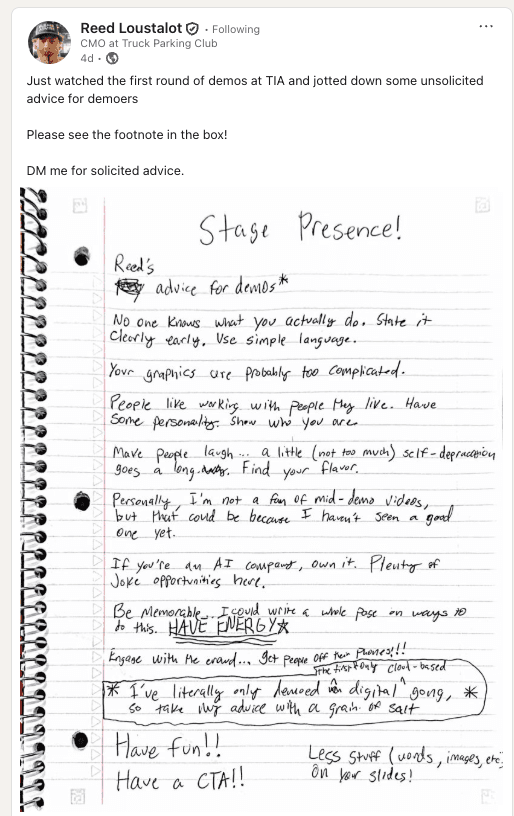
Here’s the punchline: “no one knows what you actually do.”
(Referring to those selling AI solutions in logistics)
The Real Question: How Do You Calculate AI ROI in Logistics?
Operators still have plenty of unanswered questions:
Which AI tool is best for my business?
How do I articulate the ROI of this tool to my board or manager?
Which parts of my operation are most primed for AI?
While tech providers are selling the next feature they build, operators are asking simpler, more fundamental questions: How do I even know I need AI and how do I use it in my operation?
These questions are pre-requisites to hitting the buy button. But helping logistics execs answer these questions requires a fundamentally different approach than what we’ve seen so far.
Vendors vs. Partners — The Divide That Defines AI Outcomes
The difference between the current approach and the ideal approach (the one we're after) is the difference between being a Vendor and being a Partner.
Vendors are accountable to making money on every transaction. They are solution-first by nature: selling the tool, then figuring out the use case. Trust between Vendors and their customers is often built through better market, rather than better results.
Partners are accountable to elevating the performance of the companies they partner with. Primarily, increasing profit margins over the long term. As a result, partners are more incentivized to help organizations implement AI sequentially to maximize it's utility. In other words, rather than selling you the first solution you're willing to buy, partners will help you sequence rolling out AI throughout your organization.
Why AI Gets Sold Before the ROI Is Calculated
This highlights a major flaw in the current approach: AI gets sold before the business case is built.
Ultimately, it's the operators job to do their diligence before signing a contract. However, a Partner— incentivized to improve the bottom-line performance of it's constituents— can help them form the business case: identifying gaps in the operation where AI can be most helpful.
It takes a AI Partner with deep technical expertise who helps executives map, implement, and measure AI over time. Not “here’s our solution,” but “here’s how we’ll make sure AI drives real, verifiable savings.”
The Three Stages of the AI Journey for Logistics Operators
That partnership creates value across three stages of the AI journey:
Fit: Help operators justify why and where to adopt AI.
Sourcing: Help execs separate credible AI vendors from hype.
Proof: Help execs verify that AI tools are delivering value post-adoption.
At Rilix, we’re built for that kind of partnership.
Our goal isn’t to sell AI for AI’s sake — it’s to help logistics operators capture the real savings that intelligent automation makes possible. We bring the technical depth to architect solutions and the accountability to measure results over time.
The Stakes: Capturing the ROI Opportunity in AI Logistics
Because, honestly, there is a lot at stake: logistics companies risk missing the full value of a once-in-a-generation technological wave. The technology exists — but the ability to operationalize it does not… yet.
We’re here to make sure this industry captures the AI moment and be a Partner to the logistics industry over the long haul.
Article written by
Preston Newsome

Making logistics simple
Automating all mundane tasks, so you can grow your book of business.